School libraries have always been my favourite places. As a teacher-librarian for more than a decade, I loved sharing stories and tools to help foster literacy and deep learning.
This week, I facilitated School Libraries In Today's Digital World.
Showing posts with label digital fluency. Show all posts
Showing posts with label digital fluency. Show all posts
Thursday, 13 August 2015

Saturday, 19 April 2014
Digital Badging
The Digital Badging professional development opportunity is an initiative created by the Saskatchewan School Library Association (SSLA). The professional learning opportunity, which will debut in the fall of 2014, offers badges to participants upon completion of tasks. The tasks involve the development of digital fluency skills.
Digital fluency is the ability to use digital technologies readily and strategically to learn, to work, and to play, and the infusion of technology in teaching and learning to improve outcomes for all students (Saskatchewan’s Technology in Education Framework).Participants will learn about technology tools and applications, when to use the tools to achieve the desired instructional and learning outcome, and even why the tools are likely to have the desired outcome.
Earning digital badges is a way for educators to document their professional development
accomplishments. Once a digital badge is earned, it can be placed on social networks, web sites, and portfolios as a detailed record of skills and accomplishments to various audiences.
The tasks encompass a range of digital literacy skills represented in the following model:

The tasks encompass a range of digital literacy skills represented in the following model:
The earning of digital badges involves a simple four stage process:
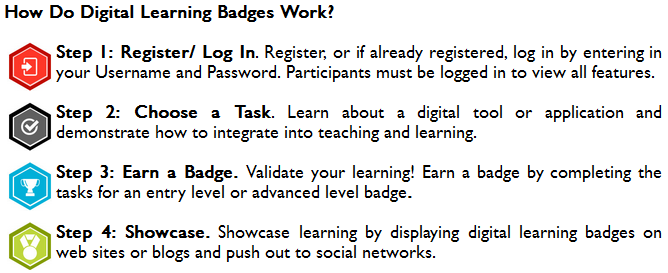
On behalf of SSLA, we welcome the participation of educators! Together, we can pave a personal learning pathway and leverage the potential for mastering digital age skills embodied in the ISTE Standards and Saskatchewan’s Technology in Education Framework.
Thursday, 14 November 2013
Digital Fluencies
 Today, it is essential that students have a wide range of skills needed to function within a rapidly changing society. In Literacy is Not Enough, authors Crockett and Jukes assert that being fluent involves learning a transparent and unconscious internalized process. A focus on fluency rather than literacy requires educators to completely rethink current assumptions about teaching, learning, and assessment.
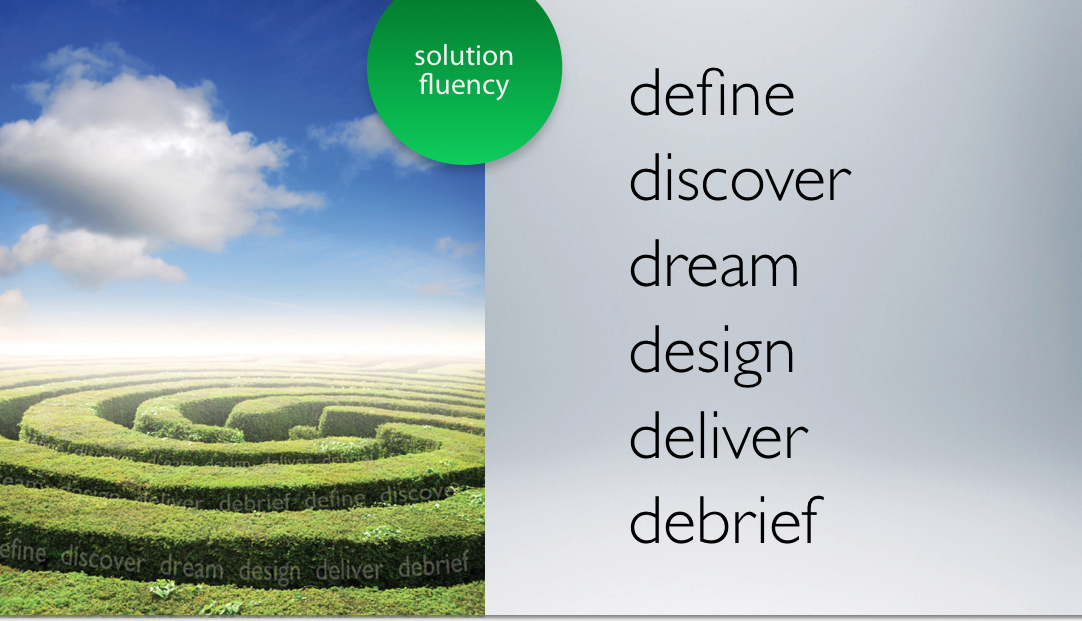
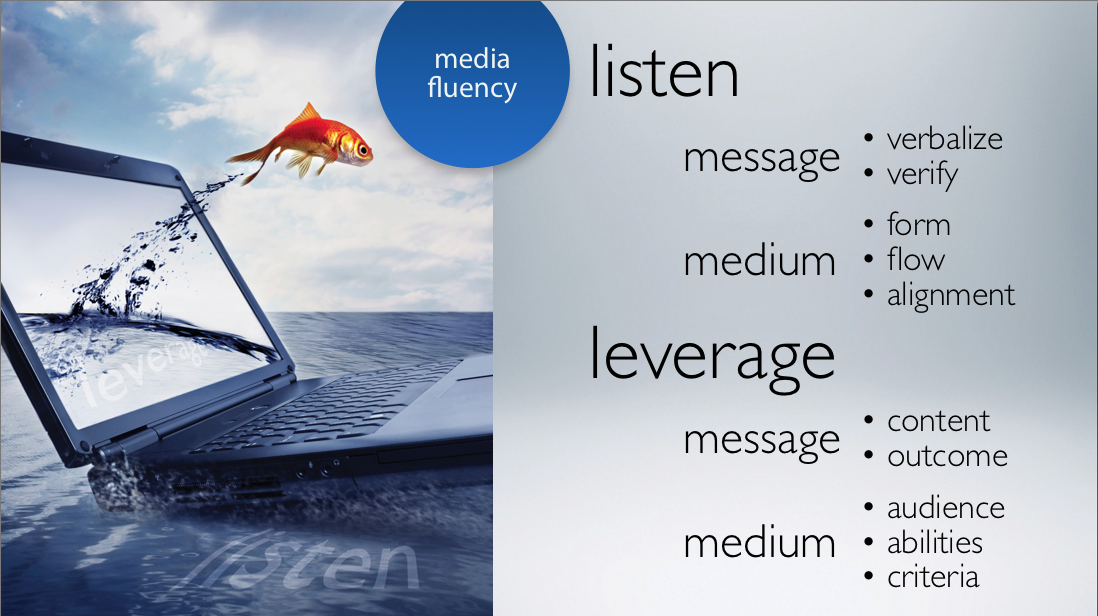
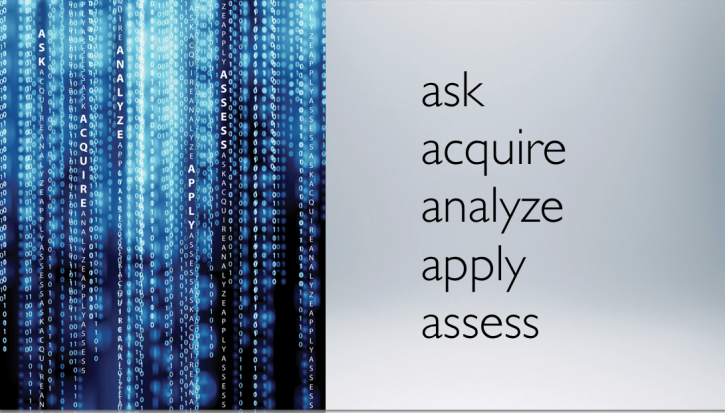
At the very heart of Crockett, Jukes, and Churches' 21st Century Fluency Project are five fluencies. Suggested resources and tools are linked to each fluency.
Solution Fluency
Creativity Fluency

Collaboration Fluency

Media Fluency
Information Fluency
Friday, 2 November 2012
Digital Fluency
In the information age, it is becoming increasingly important that students have the literacy skills to effectively and efficiently locate, analyze, and use information that is current, reliable, and relevant. Information literate students understand how knowledge is organized, how to find information, and how to remix information in such a way that others can learn from them.
This month, The Pew Research Center’s Internet & American Life Project released How Teens Do Research in the Digital World.The study renders mixed verdicts about students’ research habits and the impact of technology on their studies. According to their survey of teachers, the Internet has opened up a vast world of information for today’s students, yet students’ digital literacy skills have yet to catch up. The teachers believed that digital search tools have a mostly positive impact on student research, they had serious concerns about student distraction, their use of a narrower range of resources, their expectations of quick answers, and their difficulty finding credible sources.
Despite viewing the overall impact of today’s digital environment on students’ research habits as “mostly positive,” the teachers rated the research skills of their students as modest. A focus on digital literacy was identified as a pressing need for today's students.
ISTE's National Education Technology Standards- NETS for Students 2007
-
Research and Information Fluency
Students apply digital tools to gather, evaluate, and use information. Students:
a. plan strategies to guide inquiry.
b. locate, organize, analyze, evaluate, synthesize, and ethically use information from a variety of sources and media.
c. evaluate and select information sources and digital tools based on the appropriateness to specific tasks.
d. process data and report results.
Perhaps it needs to start with a critical look at curricular practice - an examination of pertinent practice, purposeful practice, and the essentials for our learners. Stephen Wilmarth (2009) states that technology is altering the very nature of pedagogy. As educators, we cannot expect to "think the same" about teaching when the act of teaching is shifting dramatically as a result of technology and access to information. Tim Tyson (2009) concurs by stating that effort needs to shift the culture to one that "makes learning irresistible".
If we want students to effectively and critically navigate, evaluate and create information using a range of digital technologies, we need to transform our schools into learning organizations based on pursuits that are worthy, relevant, and student-led.
Subscribe to:
Posts (Atom)
